Interval coverage for rare plankton proportions
Under Peer-Review at Environmental Monitoring and Assessment (EMA)
Abstract
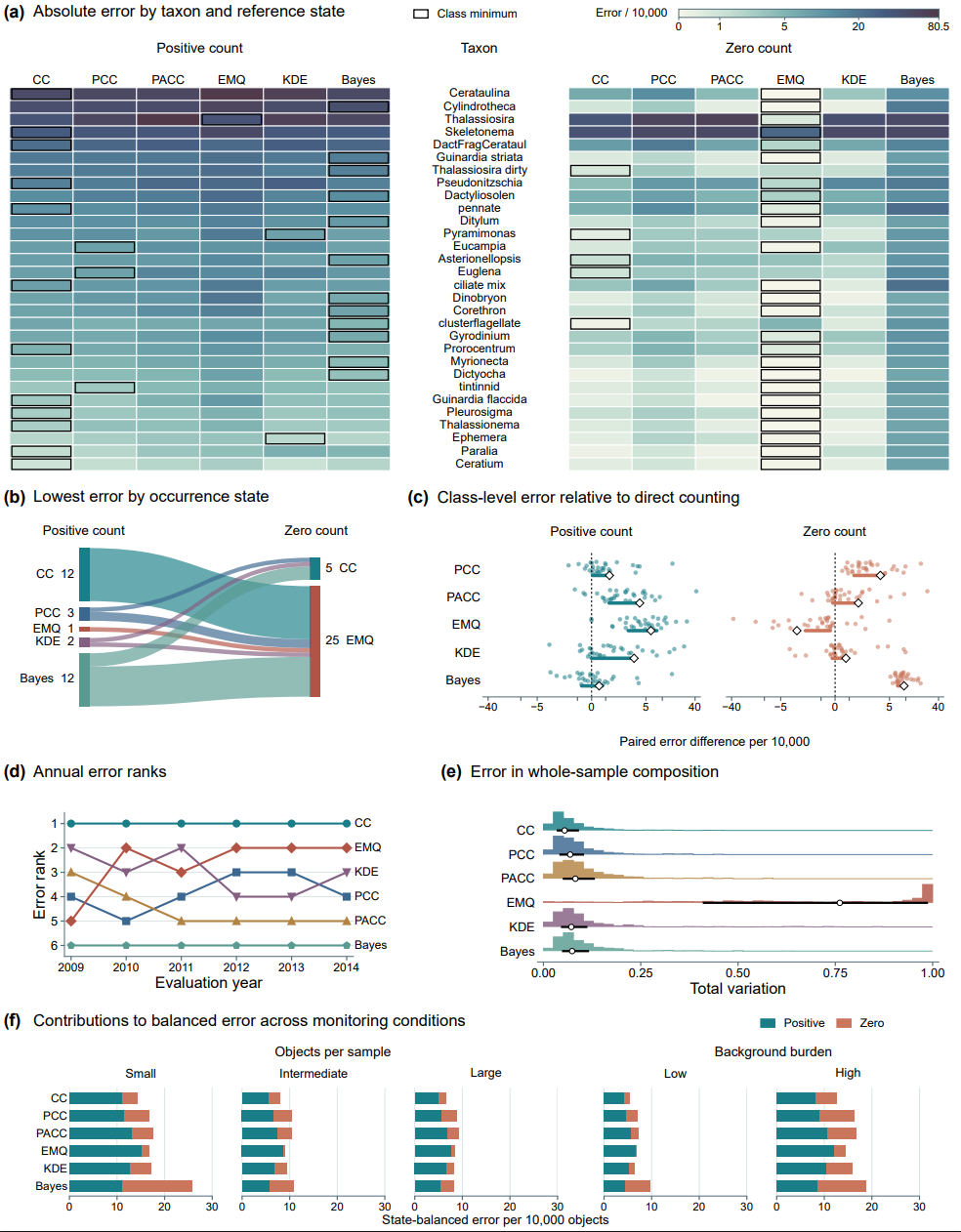
Coastal imaging surveys estimate plankton composition from thousands of objects in a water sample. For a rare taxon, an uncertainty interval can often cover the annotated proportion by including zero in samples where the taxon is absent. To assess performance when the taxon was present, I examined 678 complete samples collected over six years at the Martha's Vineyard Coastal Observatory. Thirty biological classes met abundance and support criteria set using earlier samples. For each class, I evaluated whether a nominal 90% interval from a Bayesian confusion-matrix model contained the annotated proportion of imaged objects. Averaged across classes, coverage was 88.3% overall, 81.4% when the class was present (95% confidence interval 79.5–83.4%) and 96.5% when it was absent (95.6–97.5%). Coverage was lower at positive counts for 28 classes and equal for the other two. At positive counts, the annotated proportion exceeded the upper bound in 13.7% of observations on average across classes and fell below the lower bound in 4.9%. Among six point estimators, direct counting gave the smallest absolute error when presence and absence received equal weight, equivalent to 8.52 objects per 10,000. Validating abundance intervals separately at positive and zero reference counts reveals how much confidence a monitoring programme can place in measurements of a taxon when it occurs.